How long-tail keywords push your main keyword's App Store rank
By Sam H
You’re #4 for your main keyword. You raise the bid from $1.20 to $1.30. CPA climbs to $1.50. Installs don’t move.
That’s not a bidding problem. You’ve hit the volume ceiling on that keyword — you’re already winning most of the auctions, and paying more per tap doesn’t create searches that aren’t happening. Bid stopped being your lever a while ago.
Here’s where rank actually comes from, and why your long-tail keywords matter more than you think.
Apple reads keywords as tokens
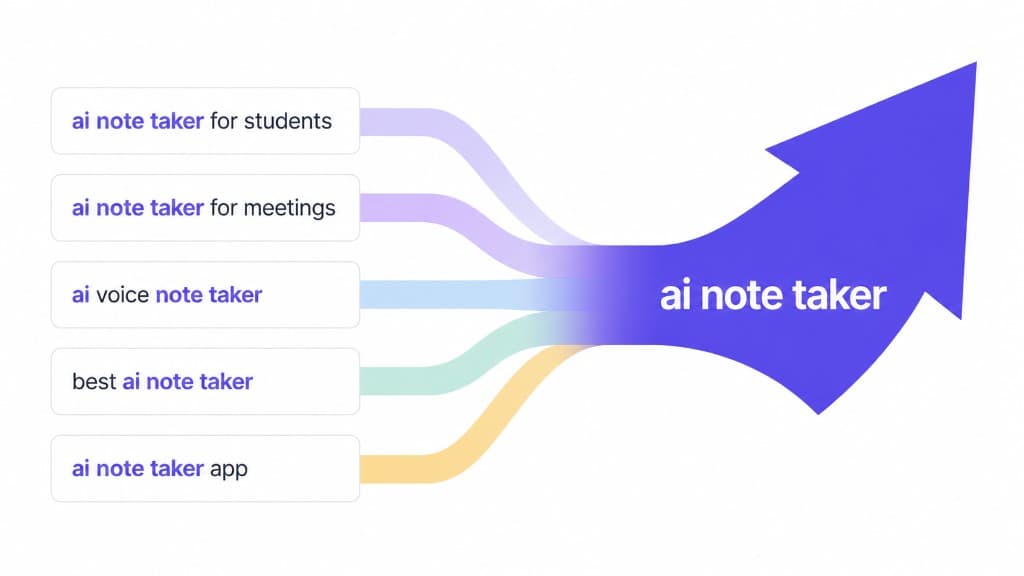
When someone searches “ai note taker for students,” Apple doesn’t treat that as one string. It breaks into tokens: ai, note, taker, for, students. An install on that search accrues relevance on every token — including note and taker, which it shares with your head term “ai note taker.”
So installs on the long-tail phrase bleed velocity back to the head term. The instinct is right.
The catch: the signal is weighted toward the exact phrase searched. 20 installs on “ai note taker for students” do not move “ai note taker” the way 20 installs on the head term itself would. It’s a real contribution to your token relevance and total app velocity — just a diluted one for that specific head ranking.
Why this still wins
Your head term is capped. You proved it with the bid test. The only way to push it 4→3 is net-new install velocity, and that has to come from somewhere other than the term you’ve already maxed.
That’s what the long-tail cluster does. “ai note taker for students,” “ai note taker for meetings,” “ai voice note taker” — each adds incremental volume you couldn’t buy on the head term, and the shared tokens compound back toward it. Stack five of them and the aggregate velocity plus token reinforcement does more for organic rank than hammering bid on the one capped keyword.
Same logic for a model-name app. “kling ai” is the head; “kling ai video creator,” “kling ai video generator,” “kling video ai” all feed it through the shared kling and ai tokens.
No cannibalization. Those are different searchers, not people who’d have found you via the head term anyway.
The mistake that kills this play
It only works if the long-tail terms actually have search volume.
This is where most people burn budget. They spin up campaigns on every variant they can think of — and half of them sit at the popularity floor. A keyword nobody searches gets you 2–3 installs a day no matter how hard you bid. Five of those is fifteen installs and a token bump too small to register. You spent a week and a budget to move nothing.
Before you build the cluster, pull popularity on every candidate. Keep the ones with real demand. Kill the floor terms — ranking #1 on a keyword nobody searches is a screenshot, not velocity.
The other lever you’re ignoring
You’re already winning impressions on the head term. Conversion rate decides how many of them become installs — and CR is itself a ranking input. Icon, first two screenshots, rating count. Improve those and you pull more installs out of the exact same auctions you’re already paying for, plus a direct rank signal. Cheapest velocity on the table.
One filter before you build the cluster
When you do build the long-tail cluster, the question isn’t only which terms have volume — it’s which ones bring users who actually pay. A keyword can drive installs and still be worthless if those users never convert to a subscription.
That’s the gap AppSkale closes: it ties each keyword to the subscription revenue it actually produces, so you feed velocity from the terms that fund the account, not the ones that just inflate install counts.