Apple Search Ads vs Facebook Ads for iOS Apps in 2026
By Sam H
You have a few hundred dollars for paid acquisition and two obvious options: Apple Search Ads or Facebook Ads. Most advice treats them like interchangeable install machines. They are not.
One buys people already searching the App Store. The other buys attention in a feed and hopes creative plus targeting finds demand. After ATT, the measurement story diverges even further. If you pick the wrong channel for your stage, you do not just waste budget. You learn the wrong lesson about whether paid acquisition works for your app.
This post is a decision guide for indie iOS apps in 2026: what each channel is good at, when to choose one first, and how to avoid comparing them on the same vanity metrics.
What each channel actually buys
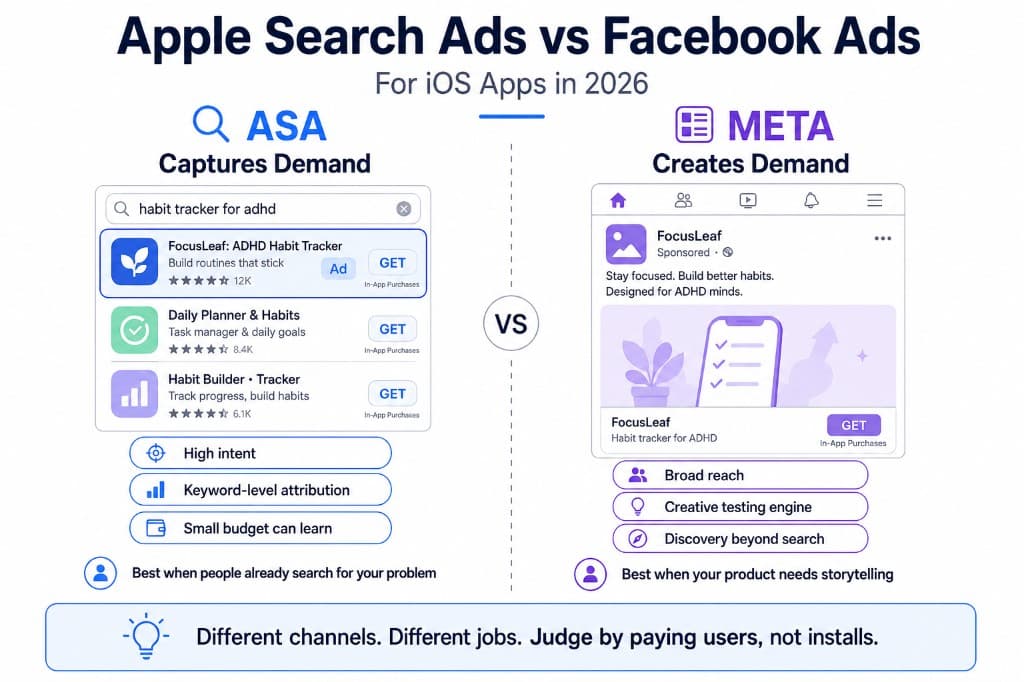
Apple Search Ads puts your app at the top of App Store search results for keywords you bid on. The user is already inside the store, already typing a problem or a product name. You pay per tap. The funnel is short: search, tap, install page, download.
Facebook Ads (Meta Ads, including Instagram) puts your creative in a social feed, Stories, Reels, or Audience Network. The user was not looking for an app. You interrupt them, earn a click or an App Store redirect, then hope the listing converts. You pay for impressions, clicks, or optimized events depending on the campaign setup.
Same goal on paper: paying users. Different jobs in practice. ASA captures existing demand. Meta creates or surfaces demand. Mixing those up is why a “cheap CPI on Facebook” can still lose to a “more expensive CPI on ASA” once trials and renewals land.
Intent vs discovery
Search intent is the structural advantage of Apple Search Ads. Someone searching “habit tracker for ADHD” or your app name is closer to a download decision than someone scrolling past a video ad between friends’ posts.
- ASA wins on intent. Brand and long-tail category keywords often convert better because the user self-selected. That is why brand defense and tight category terms matter early. See where your first $500 should go if you are still allocating that first test budget.
- Meta wins on reach and creative testing. You can find users who never searched the App Store for your category. You can also test hooks, angles, and audiences at a scale ASA keyword lists cannot match.
- ASA is constrained by search volume. If nobody searches for your problem space, ASA has little to buy. Meta can still create awareness.
- Meta is constrained by creative and privacy. Weak creative dies fast. Strong creative still fights noisier attribution and broader intent.
If your app solves a problem people already search for in the App Store, ASA is usually the cleaner first paid test. If your category has thin search volume or your growth depends on educating people that the problem exists, Meta is often the better discovery engine.
Attribution after ATT
This is where the 2026 comparison gets practical, not theoretical.
Apple Search Ads attribution is first-party inside Apple’s ecosystem. You can connect AdServices and ASA campaign data to your subscription stack with relatively clean keyword-level spend. The hard part is joining that spend to RevenueCat revenue, not guessing whether the tap happened. Setup details are in the Apple Search Ads attribution setup guide.
Meta attribution on iOS is harder. ATT opt-in rates limit deterministic tracking. SKAdNetwork and modeled conversions help Meta optimize, but indie developers often get blurrier answers to “which ad set produced paying subscribers?” You can still run Meta profitably. You should not expect the same keyword-level clarity ASA can give when revenue is connected properly.
For subscription apps, that clarity gap matters. Installs are cheap to celebrate and expensive to trust. If you cannot see revenue by source with enough confidence, you will scale the wrong thing. That is the same trap covered in your trial started, your ROAS didn’t move: early install metrics lie until conversion windows close.
When Apple Search Ads is the better first channel
Start with ASA when most of these are true:
- People already search for your category or use case in the App Store
- You monetize with subscriptions or IAP and can track revenue after install
- Your listing converts organic traffic reasonably well
- You want clean learning on a small budget before you scale creative production
- You can defend your brand name and test a short long-tail keyword list
ASA is not automatically cheaper. Competitive head terms can be expensive. It is usually clearer. For many indie subscription apps, that clarity is worth more than raw volume in the first month.
If you are still unsure whether ASA is even worth running yet, read Apple Search Ads for beginners before you compare channels.
When Facebook Ads is the better first channel
Start with Meta when most of these are true:
- App Store search volume for your category is thin or dominated by giants you cannot outbid yet
- Your product needs storytelling, demos, or emotional hooks that a search ad cannot carry
- You already have creative capacity, or you are willing to iterate ads weekly
- You are comfortable optimizing on noisier signals and validating revenue in your own backend or RevenueCat cohorts
- Your growth thesis is discovery, not capturing existing App Store demand
Meta can still be the right channel for subscription apps. It is a worse place to learn if you treat CPI as the scoreboard and never check trial and paid conversion by campaign. The channel is not the problem. Judging it like ASA keyword ROAS is.
Cost, creative, and learning budget
Rough mental model for indie budgets, not a universal price list:
- ASA learning budget: often a few hundred dollars over four to six weeks in one storefront, Exact match, small keyword list. Less creative production. More keyword and match-type discipline.
- Meta learning budget: often needs more creative variants and enough spend for the algorithm to exit learning. Cheap tests that never leave learning teach almost nothing.
- ASA ops cost: keyword research, negatives, Search Match control, weekly keyword review.
- Meta ops cost: hooks, UGC or static creative, audience testing, creative fatigue management.
Solo developers often underestimate Meta’s creative tax and overestimate ASA’s “set keywords and forget.” Both need weekly attention. ASA attention looks like keyword hygiene. Meta attention looks like new ads.
Keep Search Match off while you learn ASA. Broad auto-matching can make ASA feel like a noisy discovery channel and erase the intent advantage. Details in Search Match is eating your budget.
How to decide without fake precision
Use this sequence instead of a vibes-based coin flip:
- Check App Store demand. Search your category terms. If relevant queries exist and competitors already buy ads there, ASA has inventory worth testing.
- Check your funnel readiness. If organic installs do not trial or pay, neither channel will save you. Fix onboarding and paywall first.
- Pick the channel that matches the job. Capture demand with ASA. Create demand with Meta. Do not expect one test to answer both.
- Define the decision metric before spend. For subscription apps, that is revenue or trial-to-paid by source over a window long enough for your trial length, not day-three CPI.
- Run one channel cleanly first. Split budgets across both before you can measure either and you will not know what worked.
A practical default for many indie subscription apps with real App Store search demand: ASA first for brand plus long-tail, then Meta once you know your payback window and have creative to test. Flip that default if search demand is weak and your product needs education.
Can you run both?
Yes, later. Not as your first learning experiment.
Running both makes sense when:
- You can attribute revenue well enough to compare channels on the same outcome, not just installs
- ASA is capturing high-intent search while Meta handles top-of-funnel discovery
- You have enough budget that neither channel is starved below useful signal
Until then, one clean test beats two muddy ones. Connect RevenueCat before you scale either channel. The ROAS math is covered in how to calculate Apple Search Ads ROAS with RevenueCat. The same discipline applies to Meta: judge paying users, not download counts.
The native ASA dashboard still will not show subscription revenue by keyword. That join is the gap AppSkale is built for on the Apple Search Ads side: spend next to RevenueCat revenue so you can compare channels with less spreadsheet fiction.
Where to go next
Apple Search Ads and Facebook Ads are different products. ASA buys App Store intent. Meta buys feed attention and creative reach. After ATT, ASA usually gives cleaner learning for subscription apps that already have search demand. Meta remains powerful for discovery when you can feed it creative and validate revenue yourself.
If ASA is your first move, start with Apple Search Ads for beginners, then set up attribution with the Apple Search Ads attribution setup guide. If you are already spending and ROAS looks dead while trials are starting, read your trial started, your ROAS didn’t move before you kill the channel.
When you want keyword-level ASA spend tied to subscription revenue, AppSkale connects Apple Search Ads to RevenueCat so channel decisions are based on what users pay, not what they download.