Should You Bid on Competitor Keywords in Apple Search Ads?
By Sam H
Someone searches a rival app by name. Your ad shows up above their listing. It feels clever: steal demand that already exists. On a small Apple Search Ads budget, it can also be an expensive distraction.
Competitor keywords are not illegal in Apple Search Ads, and they are not automatically smart. Users typed another brand on purpose. You are interrupting that intent with your listing, your ratings, and your paywall. Sometimes that works. Often you pay for taps from people who already decided they wanted someone else.
This post covers when conquest is worth testing, when to skip it, and how to run a competitor keyword test without wrecking brand and category learning.
What competitor keywords actually are
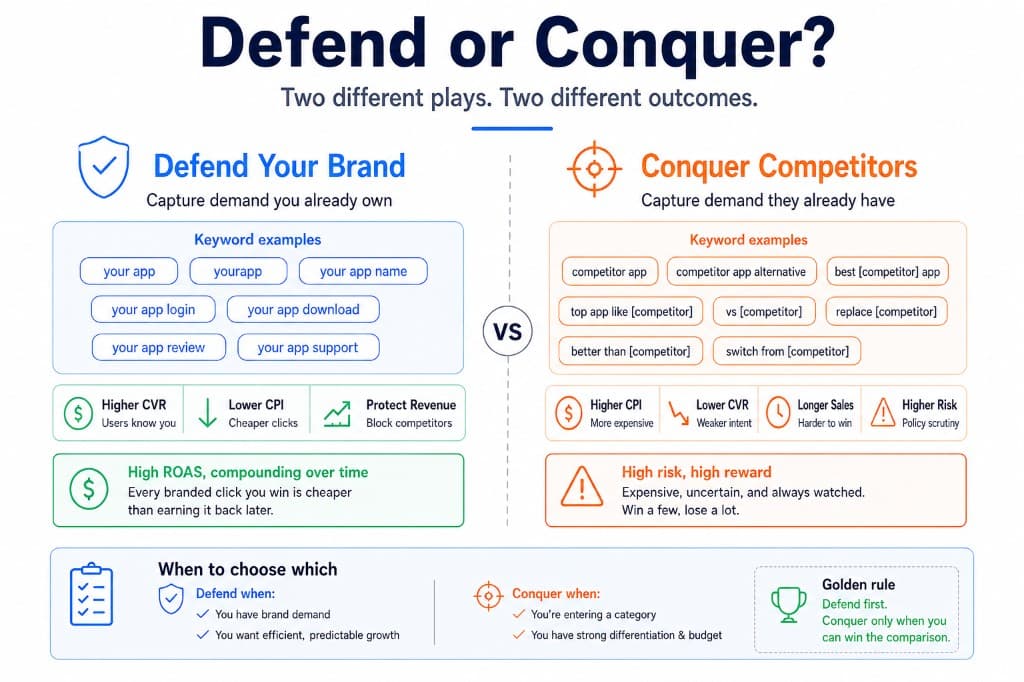
Competitor keywords are searches for another app’s name, or close brand variants of that name. Not “habit tracker for ADHD.” The rival’s product name itself.
That is different from two other buckets you should already separate:
- Your brand keywords: people searching for you. Defend these first.
- Category keywords: people searching for a problem or use case, not a company.
- Competitor keywords: people searching for a specific alternative.
If those three share one ad group, you will misread the account. Conquest traffic behaves differently from brand defense and long-tail category. Keep it separate. The same structural idea shows up in brand vs category keywords and how many keywords you should run.
When competitor bidding can work
Conquest is more plausible when several of these are true:
- Your listing can win the comparison. Stronger ratings, clearer screenshots, or a sharper promise for the same job.
- The rival is adjacent, not a giant category owner. Bidding on a massive brand with a huge review lead is usually a tax, not a strategy.
- Users are comparison shopping. Some brand searches are exploratory. Your ad can be a second look, not a rude interruption.
- You already know your own brand and category economics. If you cannot tell whether your own terms pay, you are not ready to diagnose competitor terms.
- You can measure revenue per keyword. Install vanity on conquest keywords is especially misleading.
Competitor bidding is a second-stage test, not a first-week growth hack. If ASA is still new to you, start with Apple Search Ads for beginners before you spend on someone else’s brand.
When you should skip it
Skip competitor keywords early if:
- Your first few hundred dollars are still teaching you brand and long-tail category performance
- Your ratings or screenshots lose the side-by-side in search results
- Cost per tap on rival names is high and trial starts are near zero
- You do not have attribution wired to subscription revenue yet
- You are tempted to add ten competitor names because the category list feels short
That last one is common. A quiet category ad group does not mean you should invade rival brands. It usually means your long-tail list needs better intent, or your funnel is leaking after install. See your ASA CPI looks great, your paywall conversion is terrible before you treat conquest as the fix.
Brand defense comes before brand attack
Before you bid on anyone else, own your own name.
If competitors can bid on your brand and you are absent, they show up when someone searches for you. That is the defensive version of this topic. Conquest without defense is backwards: you pay to interrupt their customers while leaving yours unprotected.
Practical order:
- Exact brand defense on your app name
- Exact long-tail category terms
- Optional small competitor test in a separate ad group
Do not let conquest keywords share budget with brand defense. Brand should stay funded even if conquest looks exciting for a week.
How to run a clean competitor test
If you decide to try it, keep the experiment boring and measurable.
- Separate ad group, Exact match only. Two to five rival names max. Not a spreadsheet of every app in the category.
- Hard daily cap. Treat conquest as tuition with a ceiling. If it cannot prove trials or revenue inside that cap, pause it.
- Search Match off. You want those exact brand queries, not Apple expanding into related noise. See Search Match is eating your budget.
- Judge on trials and revenue, not CPI. Conquest can look cheap on installs and terrible on paid conversion because intent was never yours.
- Give it a real window, then decide. If trial length is seven to fourteen days, do not call the test on day three. Timing still matters. See your trial started, your ROAS didn’t move.
Use negative keywords if Broad or Search Match elsewhere starts leaking rival-brand junk into category campaigns. And do not Broad-match competitor names unless you like surprises.
What “good” looks like on conquest
A competitor keyword earns its keep only if it produces paying users at an acceptable cost after your normal conversion lag. Installs are not enough. Curiosity taps are not enough.
- Keep if trial starts and paid conversions show up at a cost you can live with versus category terms
- Pause if spend accumulates with installs but no meaningful trials after a fair sample
- Do not scale just because CPT looks lower than a head category term. Wrong intent with cheap taps is still wrong intent.
Compare conquest ROAS to your own brand and best long-tail category keywords, not to zero. If brand is 4x and conquest is 0.3x after the trial window, the answer is obvious. The ROAS math is in how to calculate Apple Search Ads ROAS with RevenueCat.
Common conquest mistakes
- Bidding on giants first. You pay premium taps to sit next to an app with ten times your reviews.
- Mixing competitor names into category Exact. The average hides whether conquest is helping or draining.
- Copying a long rival list on day one. That steals budget from keywords you should be learning first.
- Ignoring the store listing comparison. If your screenshots lose the eyeball test, ads just buy expensive bounce.
- Calling installs a win. People tap alternatives out of curiosity all the time. Curiosity is not a subscription.
A practical default for indie apps
Default off for the first learning month. Defend your brand. Test long-tail category. Turn Search Match off. Keep Exact match clean.
Then, if the funnel converts and you still have budget, run a tiny conquest ad group with two to five Exact rival names, a hard cap, and a clear kill date after one trial cycle. Keep winners only if revenue says so. Negative or pause the rest.
Make sure attribution is set up before you run the test. Use the Apple Search Ads attribution setup guide. Without keyword-level revenue, conquest becomes vibes with a CPT column. AppSkale puts ASA spend next to RevenueCat revenue so you can see whether rival-brand taps become subscribers.
Where to go next
Bidding on competitor keywords can work when your listing can win the comparison and your measurement is ready. It is usually a bad first move on a small budget. Defend your brand, learn category intent, then run conquest as a capped experiment in its own Exact ad group.
For foundation setup, read brand vs category keywords, Exact vs Broad match, and how many keywords you should run. For revenue math once the test has had time, use Apple Search Ads ROAS with RevenueCat.
When you want to compare brand, category, and competitor keywords on paying users instead of taps, AppSkale connects Apple Search Ads spend to RevenueCat revenue at the keyword level.