Apple Search Ads Daily Budget: How Much Is Enough to Learn?
By Sam H
You decide to try Apple Search Ads, open the campaign builder, and hit the daily budget field. Five dollars feels safe. Fifty feels reckless. Twenty feels like a compromise. None of those numbers matter until you know what the budget is for: learning which keywords produce paying users, not buying the maximum installs before lunch.
Too low and you never get a fair sample. Too high and you burn cash before the funnel or keyword list is ready. The useful question is not “what do agencies spend?” It is “how much do I need, for how long, in one storefront, to make keep/pause decisions?”
This post gives a practical daily budget range for indie apps, how runway matters more than one flashy day, and when raising spend is a mistake.
Daily budget is a learning budget
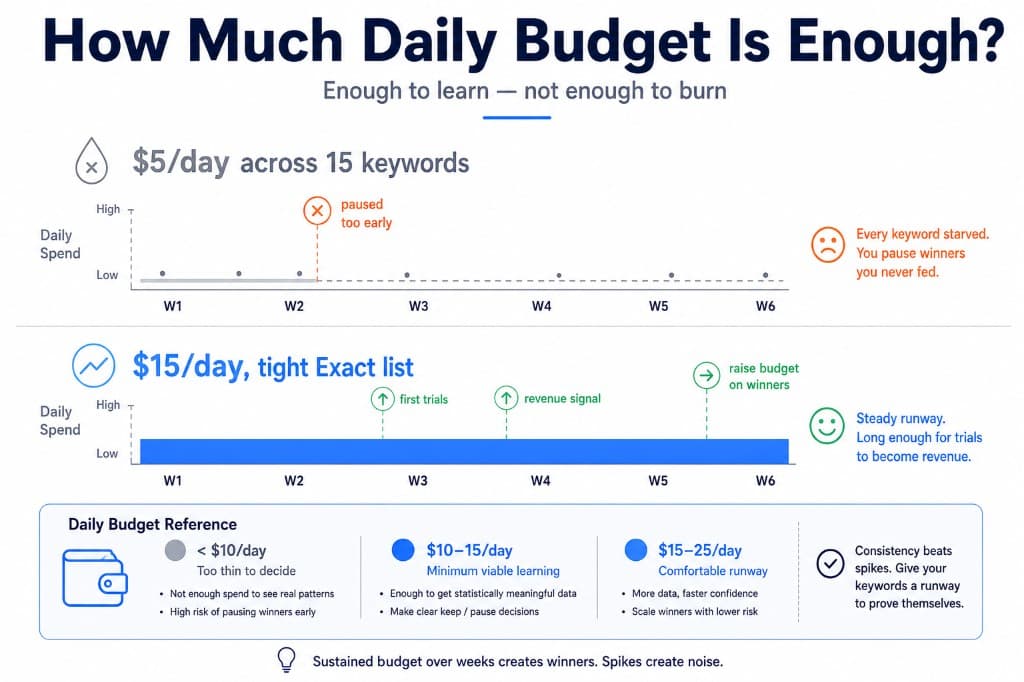
A daily cap controls how fast you spend. It does not guarantee results. At $5/day across fifteen keywords, most terms starve. At $100/day with Search Match on and a messy list, you get volume without answers.
Think in weeks, not days. Subscription apps need time for installs to become trials and trials to become revenue. A “good” daily budget is one you can sustain long enough for that lag without panic. If flat early ROAS freaks you out, read your trial started, your ROAS didn’t move before you slash the cap every morning.
A practical range for beginners
For many solo subscription apps testing in one storefront, usually the US:
- About $10–15/day: minimum viable learning if the keyword list is tight, Exact match, Search Match off
- About $15–25/day: more comfortable runway for brand plus 10–15 long-tail category terms
- Below ~$10/day: often too thin to decide anything useful across a real keyword list
- Total learning pot: roughly $300–$600 over four to six weeks is a common indie range, not a promise
Those numbers are observed ranges for small accounts, not universal truths. Competitive categories cost more per tap. Soft categories can learn on less. The principle stays the same: fund a short list long enough to read it.
If you are allocating a first ~$500, pair the daily cap with the right keyword split. See where your first $500 should go.
Why $5/day usually fails
A tiny daily budget feels responsible. It often produces fake caution:
- Keywords never get a sample. You pause terms that were just starved.
- You optimize noise. One or two random taps look like a trend.
- You quit early. After ten quiet days you declare ASA dead when the account never had oxygen.
If $5/day is truly all you can risk, do not run fifteen keywords and three countries. Run brand Exact only, or brand plus a handful of long-tail terms, in one storefront. Shrink the test until the budget can feed it. That is the same logic as how many keywords you should run.
Runway beats a big Tuesday
Doubling spend for one day does not equal two weeks of learning. ASA decisions need repeated auctions, enough taps per keyword, and enough calendar time for trials to convert.
Prefer a steady daily cap you can keep for four to six weeks over a burst you will shut off in panic. Consistency also makes weekly reviews saner: same structure, same storefront, same match types, changing only what the data earned.
If you are not sure ASA belongs in the plan yet, read Apple Search Ads for beginners before you lock a daily number.
What the daily budget has to cover
Your cap is shared across whatever is live. Structure it on purpose:
- Brand Exact: small, steady, protected. Do not let category experiments starve defense.
- Category Exact: most of the learning budget on 10–15 long-tail terms.
- Discovery later: Broad or Search Match only with a separate, smaller cap after Exact has taught you something.
One storefront first. One match type per ad group. Search Match off while you learn. Details in Exact vs Broad match and Search Match is eating your budget.
If competitor conquest is tempting, do not fund it from the same thin daily cap that is still learning category intent. Keep conquest optional and capped. See should you bid on competitor keywords.
When to raise the daily budget
Raise spend only after the account is producing decisions, not vibes.
- Raise when specific Exact keywords show trials or revenue and are limited by budget, not by bad conversion
- Hold when installs look fine but paywall or trial conversion is broken. Buying more of a leak is not learning. See your ASA CPI looks great, your paywall conversion is terrible.
- Cut or reallocate when spend hits keywords with no path to revenue after a fair sample. Use negatives and pauses before you add budget. See negative keywords.
A simple rule: increase budget on winners, not on the whole account average. Blended ROAS hides the terms that deserve money.
Daily budget mistakes
- Setting $3–5/day across a huge keyword list. Starvation dressed up as thrift.
- Raising budget because CPI looks cheap. Cheap installs can still be worthless subscribers.
- Changing the cap every day. You reset the learning loop and never finish a clean week.
- Splitting a tiny budget across many countries. Prove one storefront first.
- Funding discovery before Exact works. Broad and Search Match need spare budget, not the whole learning pot.
A simple starter plan
- Pick one storefront.
- Set a daily cap you can sustain for four to six weeks, often around $10–20/day for indie tests.
- Run brand Exact plus 10–15 long-tail Exact category keywords.
- Turn Search Match off. Keep Broad off until Exact produces signal.
- Review weekly. Pause clear losers. Do not raise budget until winners exist.
- Connect revenue tracking before you scale. Use the Apple Search Ads attribution setup guide and the ROAS math in how to calculate Apple Search Ads ROAS with RevenueCat.
The native ASA dashboard will show spend hitting the daily cap. It will not show which keywords turned that spend into subscribers. AppSkale puts keyword-level spend next to RevenueCat revenue so you raise budgets on evidence.
Where to go next
Enough daily budget is the amount that feeds a short Exact keyword list for several weeks without starving every term. For many indie apps that starts near $10–15/day, often lands around $15–25/day, and only goes up after winners appear. Runway and structure beat a scary one-day spike.
Next, lock the keyword plan with brand vs category keywords and how many keywords you should run. Keep match types clean with Exact vs Broad match. If you are still deciding whether to run ASA at all, start with Apple Search Ads for beginners.
When you want to see whether today’s spend is buying paying users or only downloads, AppSkale connects Apple Search Ads to RevenueCat at the keyword level.